

How NYC Cyclists Can Prevent Hip Impingement Re-injury and Stay Racing
Table of Contents
Understanding Hip Impingement and How Cycling Mechanics Trigger It
The Critical Window: How Re-injury Happens During Return to Training
Our Specialized Assessment Process for Cycling-Specific Hip Issues
Advanced Manual Therapy and Movement Retraining for Hip Stability
Anti-gravity Treadmill Training to Rebuild Cycling Power Safely
Shockwave Therapy and Laser Treatment for Accelerated Tissue Healing
Sport-Specific Strength Conditioning to Lock in Hip Stability
Why Hip Impingement Derails NYC Cyclists from Competition
Hip impingement is one of the most frustrating injuries affecting competitive cyclists in New York City. The condition derails training plans, forces weeks off the bike, and creates a nagging worry: will this injury come back as soon as I increase intensity? If you're a cyclist dealing with hip pain or recovering from femoroacetabular impingement, understanding the mechanics of your injury and following a structured return-to-cycling plan is essential to staying healthy and racing strong.
At NYPT Health & Rehab, we work with NYC cyclists regularly to rehabilitate hip impingement, rebuild strength safely, and create lasting protection against re-injury. This guide walks you through what causes hip pain in cyclists, how re-injury happens, and the specific strategies we use to get athletes back on the bike with confidence.
Hip impingement stops cyclists because it creates sharp, grinding pain deep in the hip joint, especially during the power phase of the pedal stroke. For competitive athletes training 10-15 hours per week, this pain isn't something you can push through. It gets worse with intensity, forces rest days, and eventually sidelines you completely.
The frustration runs deeper than missed training. Hip impingement creates uncertainty. You might feel fine on an easy spin, then experience sharp pain during a threshold interval. This unpredictability makes race preparation impossible. Many cyclists we see have already taken 4-6 weeks off and are eager to return, but they're afraid that jumping back into structured training will re-injure the hip.
This fear is justified. Without addressing the underlying mechanics that caused the impingement, re-injury rates are high. The hip is a complex joint that depends on precise muscle activation patterns, mobility, and strength across multiple planes of motion. Cycling, while repetitive and powerful, doesn't naturally develop all the stability your hip needs.
Actionable takeaway: Schedule a movement assessment before returning to your normal training volume. A single session identifying your specific mobility and strength gaps can reveal exactly why the impingement happened and what you need to fix.
Understanding Hip Impingement and How Cycling Mechanics Trigger It
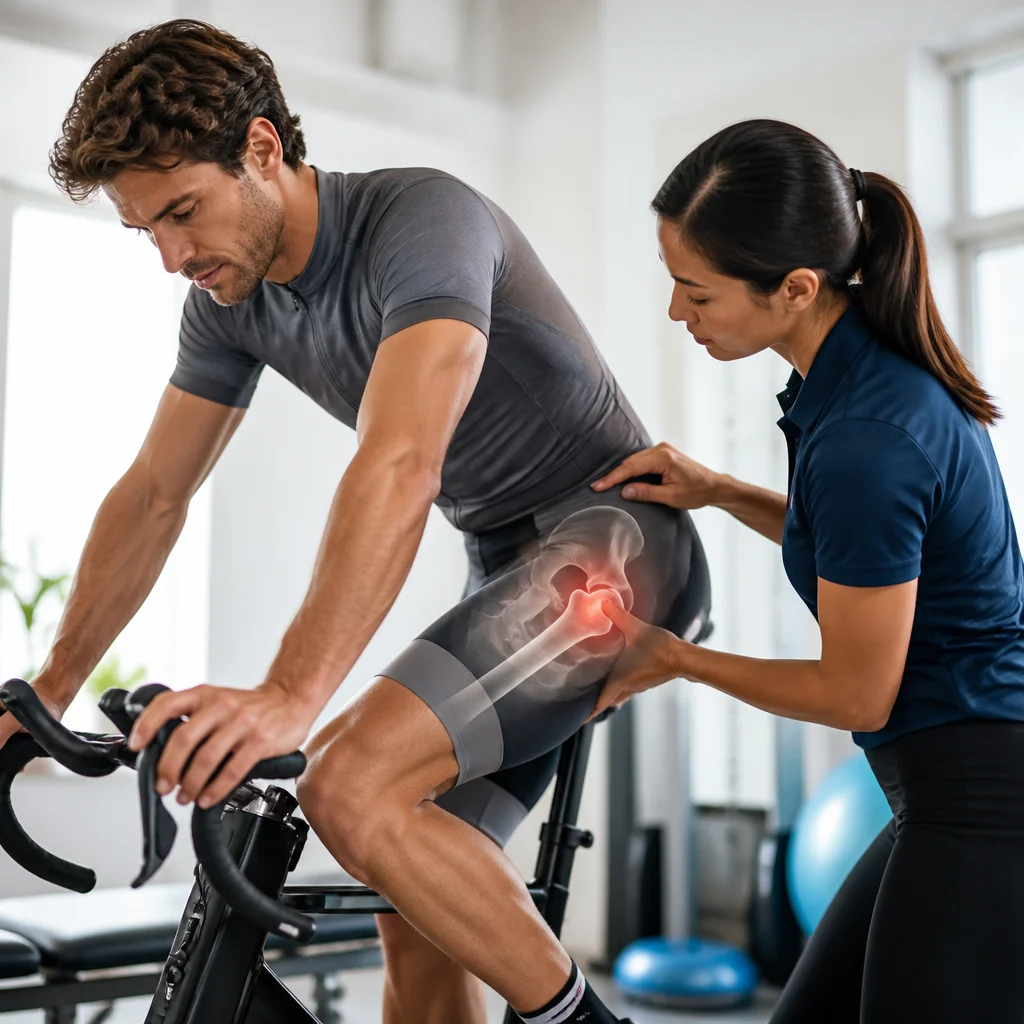
Hip impingement, also called femoroacetabular impingement (FAI), occurs when bony structures in the hip socket pinch soft tissue, including the labrum and cartilage, during certain movements. In cyclists, this typically happens because of how the hip moves during the pedal stroke combined with existing tightness or weakness.
The cycling position demands hip flexion (thigh moving toward your chest) on the downstroke and hip extension (thigh moving back) on the upstroke. If your hip flexors are chronically tight from long hours in the saddle, your hip joint runs out of available motion, causing the femoral head to pinch structures in the joint socket.
Weakness in the hip stabilizers makes this worse. Your gluteus medius, hip external rotators, and core muscles work together to keep the femur properly centered in the socket throughout the pedal stroke. When these muscles are underactive or fatigued, the femur migrates forward and inward, increasing impingement risk.
Several cycling-specific factors compound the problem:
High seat heights without proper hip flexibility lead to excessive anterior translation of the femoral head
Narrow foot positioning relative to hip width increases internal rotation stress
High cadence riding (95-110 RPM) that doesn't match your biomechanics forces compensation patterns
Sudden increases in training volume or intensity before your hip is prepared
Limited hip external rotation range, common in cyclists who don't cross-train
Addressing hip impingement means restoring your available motion and activating the muscles responsible for keeping your hip stable throughout the pedal stroke.
The Critical Window: How Re-injury Happens During Return to Training
Most re-injuries happen during weeks two through four of returning to cycling. You feel better after initial rest, start easy rides, feel no pain, then gradually increase intensity. This is the danger zone.
Here's why: your pain resolved because inflammation decreased and you stopped triggering the impingement. But the underlying movement dysfunction, muscle weakness, and mobility restrictions that caused the problem are still there. You haven't actually fixed anything yet.
When you return to harder efforts, endurance rides, or longer durations, you ask your hip to handle forces it hasn't been prepared for. The same faulty movement patterns re-engage, re-irritate tissue, and pain returns. Cyclists often assume they need more rest, but rest alone doesn't prevent re-injury. You need a structured progression that builds stability first, then gradually increases load.
The critical window requires three things:
Honest assessment of your current movement quality and strength 2. A progressive loading plan that increases duration and intensity separately, never both at once 3. Regular monitoring of movement patterns during cycling to catch compensation before it causes pain
Many cyclists skip structured rehabilitation because they're eager to return to training. This is the exact point where we see people re-injure themselves. Taking two additional weeks to do proper rehab now prevents two months of re-injury setbacks later.
Our Specialized Assessment Process for Cycling-Specific Hip Issues
We begin with a thorough evaluation focused specifically on how your hip functions during the cycling movement. This isn't a general hip assessment; we're looking at your unique mechanics.
Our process includes range-of-motion testing in all planes of motion, with special attention to hip flexion, extension, internal rotation, and external rotation. We measure differences between your left and right sides. A five-to-ten degree difference in external rotation between hips is common in cyclists with impingement.
We assess muscle activation patterns using isolated strength tests and functional movement. We're looking for which muscles are overactive and which are underactive. Many cyclists we evaluate show strong hip flexors and weak hip external rotators and abductors, the classic pattern that creates impingement.
The cycling-specific part of our assessment means watching you perform positions and movements that mimic the pedal stroke. We look at your femoral alignment, knee tracking, trunk stability, and pelvic control. Video analysis helps us show you exactly what's happening in your hip during the movements that cause pain.
We also gather information about your bike setup, training volume progression, and perceived movement quality. Sometimes adjustments to seat height, cleat position, or crank arm length play a role.
This comprehensive assessment gives us the specific data needed to build your rehabilitation plan. Rather than using a generic hip protocol, we design everything around your biomechanics and the cycling demands you'll return to.
Advanced Manual Therapy and Movement Retraining for Hip Stability
Our manual therapy and rehab approach combines hands-on treatment with movement retraining to restore both mobility and control.
Manual therapy begins with releasing tight hip flexors, tensor fasciae latae, and piriformis muscles that restrict hip motion. We use specific soft tissue techniques and gentle joint mobilization to restore available range without forcing movement through pain. This creates new motion capacity for your hip to work with.
Simultaneously, we retrain muscle activation patterns. This is where the real change happens. We use targeted exercises that activate your gluteus medius and hip external rotators in isolation first, then progress to functional positions that mimic cycling mechanics. Many cyclists are surprised how challenging it is to feel their glutes working during these early exercises. That difficulty signals which muscles need retraining.
We integrate core stability work because your core muscles stabilize your pelvis, which in turn stabilizes your hip socket. If your core is disengaged, your hip stabilizers can't function properly. Planks, dead bugs, and pallof presses create the foundational stability your hip depends on.
Movement retraining also includes hip stretches and mobility work specifically chosen based on your assessment findings. We typically focus on hip flexor flexibility, external rotation range, and active hip extension control. These are practiced daily at home, not just during sessions.
The progression moves from isolated muscle activation to integrated movement patterns. We teach you how to maintain proper hip alignment during walking, stairs, and eventually cycling-specific positions. This retraining takes four to six weeks of consistent practice to create new automatic patterns your body trusts.
Anti-gravity Treadmill Training to Rebuild Cycling Power Safely
After foundational stability work, we use anti-gravity treadmill therapy to rebuild aerobic capacity and lower-body power while unloading your hip joint. This is particularly valuable for cyclists because it mimics running mechanics but removes the impact and compressive forces that aggravate hip impingement.
The anti-gravity treadmill uses air pressure to reduce your effective body weight by up to 80 percent. You can start at 50-60 percent of your normal body weight, run at cycling-comparable heart rates and effort levels, and gradually increase load as your hip stabilizers adapt. This allows aerobic training to continue while your hip heals.
We typically use anti-gravity treadmill training two to three times per week during the return-to-cycling phase. Workouts mirror your cycling training zones: easy base-building runs, tempo intervals, and eventually high-intensity efforts. The movement pattern is different from cycling, which is intentional. Cross-training variation activates stabilizer muscles differently and builds resilience.
As body weight load increases, we monitor your movement quality. If your hips start shifting, your trunk tilts, or your pelvis loses neutral alignment, we reduce load and focus on movement quality. Power and intensity always come second to proper mechanics.
Most cyclists integrate anti-gravity treadmill training for four to eight weeks, then transition back to cycling while continuing cross-training. The combined effect is impressive: aerobic fitness maintains while hip stability improves and cycling-specific power returns.
Shockwave Therapy and Laser Treatment for Accelerated Tissue Healing
Beyond movement and strength, we use advanced modalities to accelerate tissue healing. Shockwave therapy and Class IV laser therapy address tissue damage at the cellular level.
Shockwave therapy uses focused acoustic waves to stimulate healing in tissue that's struggling to recover on its own. For hip impingement, shockwave targets the labrum, cartilage, and surrounding soft tissue. The therapy triggers increased blood flow, stimulates cellular repair mechanisms, and helps remodel scar tissue. Shockwave is particularly valuable when you have imaging findings (MRI or ultrasound) showing tissue damage beyond simple inflammation.
We typically apply shockwave therapy in sessions spaced one to two weeks apart, usually three to four total sessions. Results aren't immediate, but tissue response peaks at four to six weeks post-treatment.
Class IV laser therapy penetrates deeper than lower-level lasers and delivers more energy to promote cellular repair. The laser light stimulates mitochondria in cells, increasing ATP production and accelerating healing. For hip impingement, we target the joint capsule and surrounding musculature. Laser therapy is comfortable, non-invasive, and can be applied during movement retraining sessions.
These modalities don't replace strength and movement work; they support it. Using shockwave or laser without addressing movement dysfunction means tissue heals but movement dysfunction remains, guaranteeing re-injury. Combined with your rehabilitation exercises, however, these tools significantly accelerate return to full training.
Sport-Specific Strength Conditioning to Lock in Hip Stability
Once your basic movement quality and core stability are solid, we progress to cycling-specific strength work. This phase typically begins at week four to six of rehabilitation.
Cycling-specific strength means exercises that load your hip in planes and positions related to the pedal stroke. We use single-leg work extensively because cycling is fundamentally asymmetrical. Single-leg squats, step-ups, single-leg deadlifts, and single-leg glute bridges build the unilateral strength and balance that cycling demands.
We add resistance gradually. Bodyweight exercises progress to dumbbell work, then to barbell movements like goblet squats and split squats. The loading is always matched to your movement quality. If adding weight causes your knee to cave inward, your hips to drop, or your trunk to lean, we reduce load and refocus on control.
We incorporate rotational and anti-rotational core work because cycling involves significant frontal plane stability demands that simple planks don't address. Landmine rotations, Pallof presses, and cable woodchops train your core to resist unwanted movement, the exact demand placed on your midsection during high-power efforts.
Explosive power work enters the program in the final phase, including jump squats, bounding, and cycling-specific sprint drills. This recreates the intense forces your hip will experience during racing. If your hip is unstable during power work, you'll know before you get on the bike.
This strength conditioning phase lasts four to six weeks and runs parallel to returning to the bike. The goal is locking in stability so that cycling power returns without re-injury risk.
Personalized Return-to-Cycling Protocols at Our NYC Clinic
Your return-to-cycling plan is written specifically for your hip and your training goals. We don't use generic timelines; we use movement quality and how your hip responds to load.
We structure the return in phases:
Phase One (Weeks 1-2): Short, flat rides at low intensity, 20-30 minutes maximum. Focus is exclusively on comfort and movement quality. We're re-establishing the neural pathways between your brain and hip stabilizers.
Phase Two (Weeks 3-4): Gradually increase duration to 45-60 minutes at the same low intensity. Add one ride that includes gentle rolling terrain, but no sustained climbing or hard efforts.
Phase Three (Weeks 5-6): Introduce threshold intervals at low volume (3-4 x 5 minutes) or short climbs at controlled effort. Maintain one easy long ride weekly. Your highest intensity stays below competitive efforts.
Phase Four (Weeks 7+): Gradually increase interval volume and intensity. Add sport-specific training (race pace repeats, climbing intervals) as movement quality remains stable.
Each phase lasts only as long as your hip feels stable and pain-free. If pain emerges, we pause intensity increases and address what triggered it. This is why one-on-one sessions matter. We can adjust your plan in real time rather than following a fixed protocol that doesn't account for your individual response.
We monitor movement quality throughout. Every few weeks, we reassess your hip stability during cycling-specific positions. If your gluteus medius is tiring or your hip stabilizers are fatiguing, we know you need more strength work before intensity increases.
Long-term Hip Health Strategies for Competitive Cyclists
Returning to racing is important, but maintaining hip health for your entire cycling career matters more. Chronic hip impingement is preventable with consistent attention to mobility, strength, and training smart.
We recommend that cyclists do ongoing hip mobility work indefinitely. Tight hip flexors are inevitable given bike time. A five-minute daily routine of hip flexor stretches, external rotation stretches, and glute activation prevents stiffness from accumulating. This small daily investment prevents major injury down the road.
Strength maintenance is similarly important. Once you've built solid hip stability, maintaining it requires just two focused strength sessions per week. Even during heavy racing blocks, these two sessions preserve the stability you worked hard to build.
Smart training progression matters throughout your career. Never increase volume and intensity simultaneously. If you're adding weekly mileage, keep intensity moderate. If you're adding hard interval sessions, keep volume stable. This principle prevents the overload that triggered your initial impingement.
Consider annual movement assessments, especially before racing seasons. Small movement quality changes are easier to correct than full-blown re-injury. We can catch compensation patterns early and adjust your training accordingly.
Finally, listen to your body. Hip impingement doesn't appear overnight. You feel twinges, brief discomfort, or stiffness weeks before serious pain emerges. When you notice these early warning signs, address them immediately with a short mobility routine or an assessment session rather than waiting until pain forces you off the bike.
Hip impingement recovery is possible, and return to competitive cycling is realistic. What determines success is committing to proper rehabilitation, rebuilding stability systematically, and maintaining the strength and mobility that protects your hip long-term.
If you're an NYC cyclist dealing with hip pain or returning from hip impingement, we'd like to help. Contact us at NYPT Health & Rehab for a cycling-specific hip assessment. We'll show you exactly what's happening in your hip and build a personalized plan to get you back racing strong and pain-free.
Frequently Asked Questions (FAQ)
How do we assess whether you're ready to return to cycling after hip impingement?
We start with a comprehensive evaluation that includes cycling-specific movement analysis, range of motion testing, and strength assessments to understand exactly how your hip responds to cycling mechanics. Our team observes your pedal stroke, evaluates your hip stability under load, and uses our findings to identify any movement compensations that could trigger re-injury. Only once we confirm you have adequate hip stability, flexibility, and cycling-specific strength do we progress you toward sport-specific training.
What makes our hip rehabilitation approach different for cyclists?
We recognize that cyclists have unique biomechanical demands, so we tailor every phase of your recovery around your sport. Our process combines advanced manual therapy to restore hip mobility, anti-gravity treadmill training to rebuild power without joint stress, and sport-specific conditioning that reinforces hip stability during the exact movements that challenged you before. We also integrate shockwave and laser therapy to accelerate tissue healing, giving you a faster pathway back to racing without compromising your recovery.
How do we help prevent hip impingement from coming back once you return to training?
We develop a personalized long-term strategy that includes ongoing hip flexibility work, cycling-specific strength maintenance, and regular movement quality checks. Our team teaches you how to recognize early warning signs of compensation patterns and provides you with a sustainable home program designed to keep your hip healthy throughout your competitive season and beyond.
Comments