

Preventing Hip Impingement Re-injury: A Competitive Cyclist's Recovery Guide
Table of Contents
Why Cyclists Are Vulnerable to Hip Impingement Injuries
Cycling demands repetition. Your legs complete thousands of revolutions per ride, and that rhythm builds both power and vulnerability. If you've experienced hip impingement, you know the frustration: that pinching sensation limiting your range of motion, sharp pain during climbs, and the worry that you'll never return to your previous performance level.
The good news is that re-injury isn't inevitable. With the right recovery strategy and personalized rehabilitation, competitive cyclists can not only return to racing but do so with greater resilience than before. We've worked with many urban athletes who faced the same concerns, and we've learned that prevention requires understanding how your hip works, addressing the root causes of impingement, and building a training plan that supports long-term cycling health.
Cycling places unique demands on your hip joint. The repetitive flexion and rotation, combined with the forward-bent posture on a road or track bike, creates an environment where hip impingement risk increases substantially. Unlike runners who have impact variation or swimmers with fluid resistance, cyclists perform the same motion hundreds of times per hour in a fixed position.
Your hip socket has limited space, and when soft tissue structures like the labrum or bursa get squeezed between bone surfaces, inflammation and pain develop. The problem often starts subtly. You might notice stiffness after long rides or reduced power on climbs, attributing it to general fatigue rather than recognizing the mechanical dysfunction beneath the surface.
What we see frequently in our clinic is that cyclists often adjust their position or reduce mileage temporarily, but without addressing the underlying weakness or mobility restriction, the injury recurs. The cycling-specific demand for hip flexion means that without targeted intervention, your body simply repeats the same faulty pattern.
Actionable insight: Monitor how your hip feels during the first 10 minutes of a ride. Stiffness that resolves is normal; sharp or deep pain that persists or worsens is a signal to seek assessment before the issue compounds.
Understanding Hip Impingement: Mechanics and Risk Factors
Hip impingement, also called femoroacetabular impingement (FAI), occurs when bone structures or soft tissues in the hip compress during certain movements. There are structural factors (the shape of your femoral head or hip socket) and functional factors (how your muscles stabilize and move the joint).
As a cyclist, your primary risk factors include:
Limited hip internal rotation, which forces compensation through your lower back or knee
Weak hip abductors and external rotators, placing excess load on the labrum
Anterior hip tightness from prolonged flexed postures
Improper bike fit that locks your hip into a compromised angle
Insufficient core stability, allowing excessive hip motion during pedaling
Rapid increases in training volume without adequate tissue adaptation
The mechanics matter because they dictate your recovery strategy. A structural limitation requires different mobility work than a stability deficit. That's why generic online exercises often fail: they don't address your specific impingement pattern.
Common Re-injury Patterns We See in Competitive Cyclists
Re-injury happens when cyclists return to their previous training load without addressing the reason the injury occurred in the first place. We observe several predictable patterns.
The most common is the early return trap. You feel better, resume training at pre-injury intensity, and within two to four weeks the pain returns. Your tissues healed, but your hip mechanics didn't change. The same compression forces that caused initial pain are still present.
Another pattern is incomplete mobility work. Cyclists address tightness in their hip flexors with stretching alone but neglect the internal rotators, deep hip stabilizers, or thoracic spine mobility that cycling tightness affects. Pain subsides but functional limitation remains, creating a vulnerability window.
We also see athletes who ignore bike fit corrections. Your equipment is part of your treatment plan. A frame too large, saddle positioned incorrectly, or cleats misaligned will sabotage even excellent physical therapy progress.
The third pattern involves returning to cycling before establishing ground-based strength. Cycling is your sport, not your rehabilitation tool. Jumping back onto the bike before your hip can control single-leg movements, resist external forces, or stabilize through different planes of motion leaves you exposed to recurrence.
What to do next: Before resuming cycling, verify you can perform single-leg calf raises, lateral band walks, and controlled internal rotation movements without compensation or discomfort.
How One-on-One Physical Therapy Prevents Recurrence
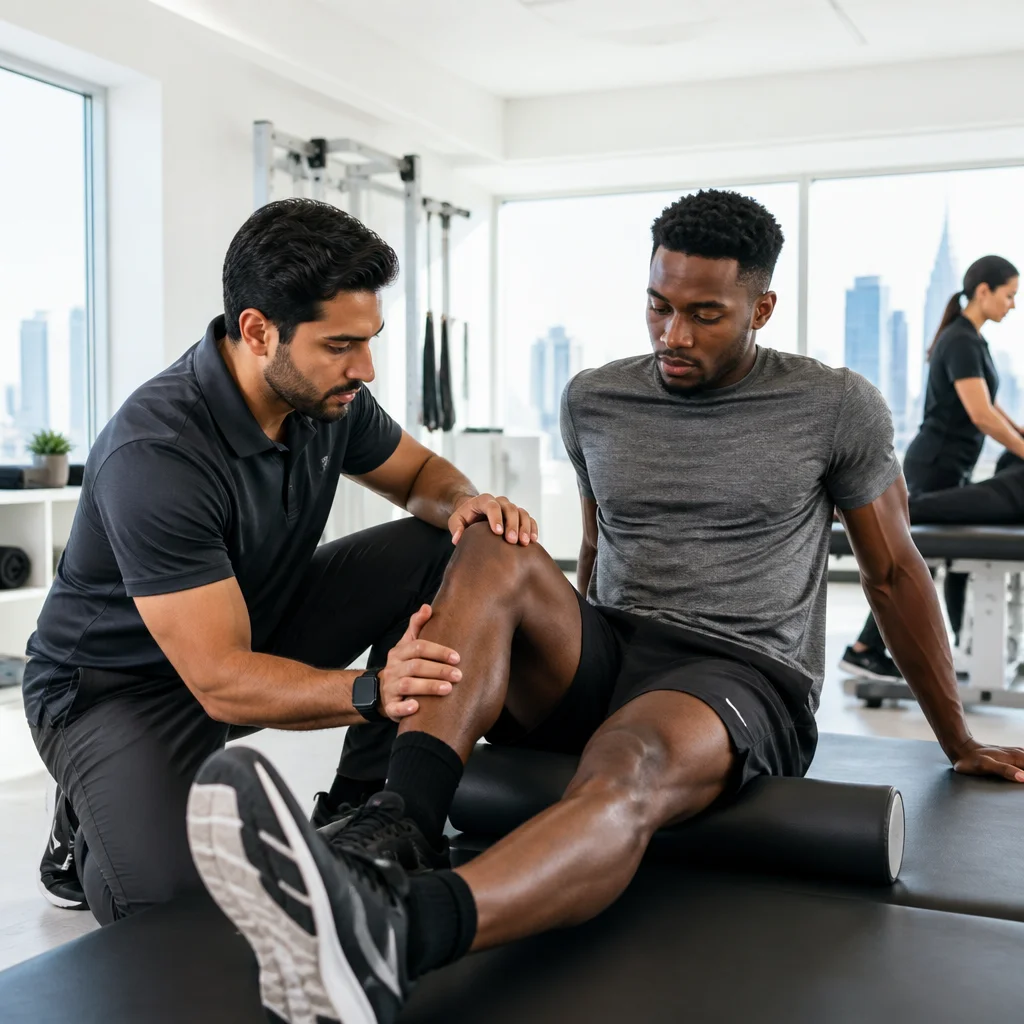
Generic group classes or home exercise programs can't account for your individual hip structure, cycling history, or specific impingement pattern. One-on-one physical therapy with a specialist gives us the ability to assess your hip comprehensively, identify the exact mechanisms contributing to your injury, and design a protocol specific to your needs.
During your initial assessment, we evaluate your hip range of motion in multiple positions, test muscle strength across all hip planes, analyze your pedaling mechanics on a stationary bike, and review your bike fit. This detailed information forms the foundation of your recovery plan.
Our approach progresses systematically. We begin with pain reduction and basic mobility restoration, move into activation of inhibited hip stabilizers, advance to sport-specific strength, and finish with integrated cycling movements that challenge your hip under realistic demands. Each phase builds on the previous one, ensuring tissues adapt gradually and movement patterns solidify.
One-on-one sessions also allow us to modify exercises in real time based on your response. If an exercise aggravates your impingement, we adjust it immediately rather than having you struggle through it at home. This responsiveness accelerates progress and prevents setbacks.
Advanced Manual Therapy Techniques for Hip Stability
Manual therapy targets the soft tissue restrictions and joint mobility limitations that contribute to impingement. Our team uses advanced techniques including joint mobilization to restore hip capsule mobility, soft tissue release for overactive hip flexors and external rotators, and targeted trigger point work for muscles tightened by years of cycling posture.
Instrument-assisted soft tissue mobilization allows us to address deeper restrictions in hip musculature that traditional hands-on techniques might miss. We also employ myofascial release strategies for the tensor fasciae latae and gluteus medius, muscles that profoundly influence hip mechanics in cyclists.
Manual therapy isn't just about feeling better temporarily. Each session educates your neuromuscular system about what normal hip movement feels like. Your brain adapts, and that improved motor control persists between sessions.
Combined with your strengthening work, manual therapy accelerates the transition from pain to function, reducing your overall recovery timeline and building confidence that your hip can handle the demands you'll place on it.
Building Cycling-Specific Strength and Conditioning
Cycling strength work differs from general fitness because it must support the specific demands of your sport. Your glutes need endurance and power; your hip abductors need dynamic stability; your core needs to transfer force without compensation.
Our cycling-specific strength program emphasizes progressive resistance exercises in multiple planes. We use single-leg movements like step-ups and split squats to build unilateral control, lateral band work to strengthen hip abductors under load, and rotational exercises to develop core power needed for attacking and sprinting.
We also incorporate loaded carries, lateral lunges, and sagittal plane movements that challenge your hip through full range of motion without provoking impingement. As you progress, we add instability, speed, and sport-specific positions to ensure your strength translates to cycling performance.
The goal is to build redundancy. If one muscle stabilizer fatigues, others can support your hip joint. This muscular backup system is what separates cyclists who return to racing from those who experience recurring pain.
The Role of Anti-Gravity Treadmill Training in Recovery
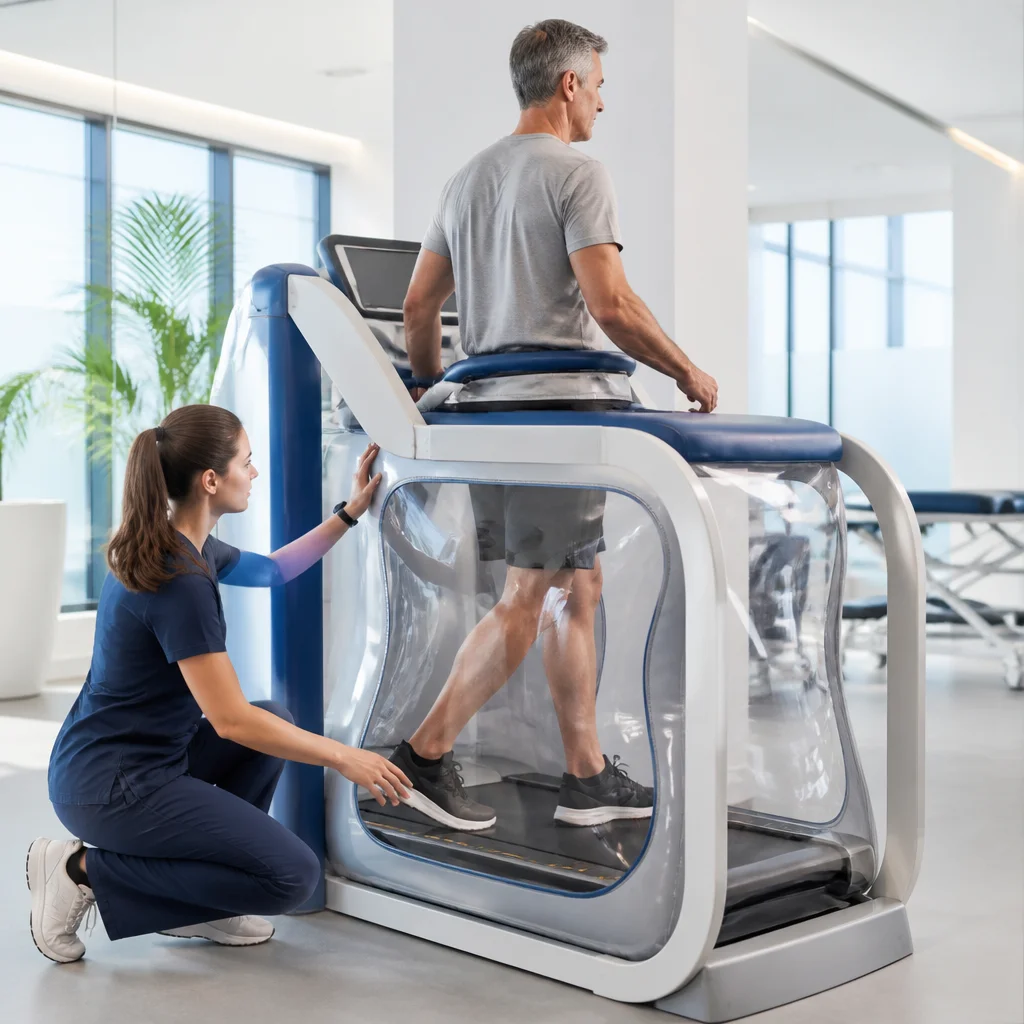
An anti-gravity treadmill is one of our most effective tools for cyclists returning from hip impingement. This device uses unweighting technology to reduce the force through your hip joint while you run or walk, allowing you to load your hip and lower extremity without triggering impingement symptoms.
For cyclists specifically, anti-gravity treadmill training provides several advantages. You can maintain cardiovascular fitness during rehabilitation without the seated hip flexion position that bikes require. You load your hip stabilizers through different ranges of motion and movement patterns than cycling offers, creating adaptability. You also build confidence that your hip can tolerate dynamic activity.
We typically use the anti-gravity treadmill to complement your strength work. You might perform hip stability exercises in the clinic, then finish with 15-20 minutes of unweighted treadmill training at a conversation-pace intensity. Over several weeks, we gradually increase weight-bearing, transitioning you from 60% body weight to 100%, mirroring the progression your tissues need.
The device also gives us objective data about your recovery. Your ability to walk or run at specific inclines and speeds with reduced weight provides measurable benchmarks for progression.
Sport-Specific Return to Action Protocols
Returning to cycling requires a structured progression. Jumping directly to your previous training intensity and duration invites re-injury. Our return-to-action protocol is gradual, planned, and measurable.
Phase one involves low-intensity stationary bike work in a pain-free range of motion. You might spend 20-30 minutes at a very low resistance, focusing on smooth pedal strokes and feeling your hip move without compensation. Your goal is movement quality, not power.
Phase two gradually increases duration and resistance. You progress to 40-50 minutes on the stationary bike, introducing short intervals at moderate intensity. We monitor how your hip responds and adjust if you develop symptoms.
Phase three transitions to outdoor cycling with rolling terrain, starting with short rides of 30-45 minutes. You continue intervals and gradually reintroduce climbs as your hip demonstrates stability and control.
Phase four involves return to structured training and racing. We coordinate with your coach or training program, ensuring you increase intensity and volume progressively rather than jumping back to your pre-injury schedule.
Throughout each phase, we assess your hip control, monitor your pain response, and adjust the progression based on your individual adaptation. This prevents the common mistake of returning too quickly and triggering recurrence.
Integrating Yoga and Mobility Work Into Your Training
Yoga and dedicated mobility sessions complement your strength and cycling training by addressing hip restriction and building body awareness. Unlike static stretching done passively, our integrated yoga approach uses active ranges of motion, challenges your stabilizers, and helps you recognize compensation patterns before they become habitual.
Deep hip openers like pigeon pose, 90-90 stretches, and low lunge variations improve hip capsule mobility and internal rotation. We pair these with stability-focused poses like single-leg glute bridges and side planks that reinforce the strength work you're doing in physical therapy sessions.
Many cyclists benefit from twice-weekly yoga sessions during rehabilitation. This frequency allows consistent mobility work without overwhelming your training schedule. As you return to competition, yoga maintains the mobility gains you've built and provides active recovery on lower-intensity days.
Mobility work also serves a psychological purpose. It gives you dedicated time focused on your body, builds confidence that your hip can access full motion, and creates a mindfulness practice around movement. Cyclists who engage with mobility work tend to have better long-term outcomes because they remain body-aware and address minor issues before they become injuries.
Why Personalized Assessment Matters Before Returning to Competition
Before racing, you need a comprehensive assessment confirming that your hip is ready. This isn't a simple pain check. We evaluate your hip in multiple positions, test your strength through full ranges of motion, assess your muscular endurance specific to cycling demands, analyze your bike fit with your updated hip mechanics, and simulate race-pace demands to ensure your stability holds.
During this pre-return assessment, we look for symmetry. Can you produce the same force with both legs? Do you demonstrate balanced hip mobility and strength? Are your movement patterns stable when fatigued? These measures tell us whether your recovery is complete or whether additional work is needed.
We also review your training history and cycling schedule. Are you returning to a big event immediately, or do you have time to build gradually? Do you have adequate base fitness, or are you trying to return at high intensity after extended time away? Context matters.
A thorough assessment takes the guesswork out of returning to competition. You get clear answers about readiness, and you avoid the false confidence that leads to re-injury.
How Our Comprehensive Approach Keeps You Cycling Long-Term
Hip impingement recovery isn't about quick return to racing. It's about building a resilient hip that can sustain your cycling goals for years. Our comprehensive approach integrates one-on-one physical therapy, advanced manual techniques, sport-specific strength and conditioning, cutting-edge modalities like anti-gravity treadmill training, and lifestyle practices like yoga into a unified treatment plan.
Each component addresses different aspects of your recovery. Therapy improves your hip mechanics. Strength builds your resilience. Mobility maintains your range of motion. Sport-specific work prepares you for cycling demands. The integration ensures no gaps in your recovery and no overlooked contributors to your original injury.
This approach also educates you about long-term hip health. You learn which exercises prevent impingement, which positions you should avoid, how to monitor your body for early warning signs, and how to adjust your training if you develop minor symptoms. You become an informed advocate for your own health.
Many cyclists we work with return to competitive racing and remain injury-free for years. They attribute this success not just to the rehabilitation but to the understanding and habits they built during recovery. That's our goal: not just fixing your current injury but equipping you to prevent future ones.
If you're struggling with hip impingement or concerned about re-injury, we're here to help. We offer detailed movement assessments, personalized one-on-one rehabilitation, and the full range of advanced therapies designed specifically for returning athletes. Let's work together to get you back to the cycling you love, performing at your best.
For further reading: Hip impingement prevention for cyclists.
Frequently Asked Questions (FAQ)
How do we prevent hip impingement from happening again after my initial recovery?
We focus on three core elements: restoring proper hip mobility through advanced manual therapy, building cycling-specific strength that protects your hip joint during hard efforts, and teaching you movement patterns that reduce impingement risk on the bike. Our one-on-one sessions address your individual biomechanics so we can identify and correct the specific factors that contributed to your initial injury before you return to competition.
What makes one-on-one physical therapy better for hip impingement than general rehab programs?
We customize every aspect of your recovery to your body and your sport, rather than following a generic protocol. During your sessions with us, we continuously assess how your hip responds to different positions and loads, then adjust our manual therapy techniques, strength work, and return-to-cycling progressions based on what we observe in real time.
When can I safely return to competitive cycling after hip impingement treatment?
We develop a sport-specific return to action protocol tailored to your recovery progress and cycling demands, using tools like our anti-gravity treadmill to safely load your hip before you're back on the bike. We won't clear you to return until we've confirmed through our assessment that your hip stability, strength, and movement quality can handle the demands of your cycling level.

Comments