

7 Best Strategies for Meniscus Repair Return to Play Success
Table of Contents
1. Understanding Your Meniscus Injury and Repair Options
A meniscus tear can feel like a career-threatening setback for any active New Yorker or competitive athlete. The good news: modern meniscus repair surgery combined with structured rehabilitation gives you a genuine pathway back to the sports and activities you love. We've worked with hundreds of athletes navigating this exact journey, and we've learned that success depends less on the surgery itself and more on the quality of your post-operative recovery plan.
The difference between returning to play as your former self versus returning at a fraction of your capacity often comes down to following a progressive, science-backed rehabilitation protocol tailored to your specific injury and sport. This guide walks you through seven proven strategies we use at NYPT Health and Rehab to help athletes achieve meniscus repair return to play success.
Your meniscus is a C-shaped piece of cartilage that acts as a shock absorber between your femur and tibia. Tears happen in different patterns and locations, and where your tear occurs directly influences your recovery timeline and return-to-play expectations.
Some meniscus tears are repairable through arthroscopic surgery, while others require a partial or complete meniscectomy (removal). Repair-based surgeries generally demand longer rehabilitation timelines because the goal is to protect the healing tissue, whereas meniscectomy patients often progress faster but face different long-term considerations.
Before starting any rehabilitation program, clarify with your orthopedic surgeon:
What type of tear you sustained (radial, longitudinal, bucket-handle, etc.)
Whether your repair is a simple stitch, all-inside repair, or outside-in technique
Your surgeon's specific weight-bearing and range-of-motion restrictions for the first weeks
The timeline your surgeon recommends before progressing to sport-specific drills
This clarity prevents setbacks caused by pushing too hard too soon or, conversely, losing valuable progress by being overly cautious. We recommend getting these answers in writing and sharing them with your physical therapist before your first session.
Actionable takeaway: Schedule a pre-rehabilitation consultation with your surgeon to document your specific repair type and restrictions. Bring this documentation to your first physical therapy appointment so your therapist can design a protocol that respects your individual healing constraints.
2. The Critical First Phase: Immediate Post-Surgical Protection
The first 2-4 weeks after meniscus repair surgery are your most vulnerable window. Your repair site is still forming scar tissue, and aggressive loading or excessive motion can disrupt the healing process entirely. This phase requires disciplined adherence to weight-bearing restrictions and range-of-motion limitations, even though your pain levels might be lower than you expect.
Many athletes make the mistake of confusing reduced pain with tissue readiness, then advance their activities prematurely. We see this backfire regularly: a patient feels good, begins walking without crutches ahead of schedule, and ends up re-tearing their repair. Patience here directly determines whether you return to sport or return to the operating room.
During this phase, your focus is swelling management and gentle motion within surgeon-approved ranges:
Use ice and elevation consistently to minimize fluid accumulation around the joint
Perform quad sets and straight-leg raises if cleared by your surgeon (these activate your quadriceps without bending the knee)
Begin gentle passive range of motion if your surgeon approves, typically 0-90 degrees of knee flexion
Maintain upper body strength with non-weight-bearing exercises to avoid deconditioning
We work closely with you during this phase to ensure you understand the "why" behind each restriction. When you comprehend that protecting your repair now prevents months of additional recovery later, you're far more likely to stick to the plan.
Actionable takeaway: Create a written protocol checklist with your surgeon's exact weight-bearing, range-of-motion, and activity restrictions. Place it somewhere visible and check it off daily to prevent unintended violations during the fog of early post-op recovery.
3. Progressive Range of Motion Restoration Techniques
Weeks 3-8 mark the transition toward active range of motion work. Your repair has formed initial scar tissue, and now the goal shifts to gradually restoring full knee extension and flexion without compromising healing.
This progression is where many athletes either stall (moving too slowly and developing stiffness) or exceed boundaries (progressing too fast and damaging the repair). The sweet spot requires careful, incremental loading.
Effective progression follows this general sequence:
Passive range of motion (therapist moves your knee)
Active-assisted range of motion (you move your knee with therapist support)
Active range of motion (you control the movement independently)
Active range of motion against light resistance
We use manual therapy techniques combined with controlled stretching to restore mobility. Prone hanging (lying face-down with your leg off the edge of a table) helps gravity gently restore knee extension. Supine wall slides let you slide your heel up a wall to gradually increase flexion without aggressive end-range pressure.
Progress is measured in degrees of motion, not feelings. If your surgeon's goal is 90 degrees of flexion by week 6 and you're at 78 degrees at week 5, we maintain the current exercises. We don't accelerate based on frustration.
Actionable takeaway: Measure your knee flexion and extension with a simple goniometer (angle measurer) weekly and log the numbers. Compare your injured knee to your non-injured knee. Aim for incremental 5-degree gains every 1-2 weeks rather than dramatic jumps.
4. Advanced Manual Therapy for Faster Healing
By weeks 6-10, your repair site has matured sufficiently to tolerate skilled manual therapy. This is where our advanced techniques accelerate functional recovery.
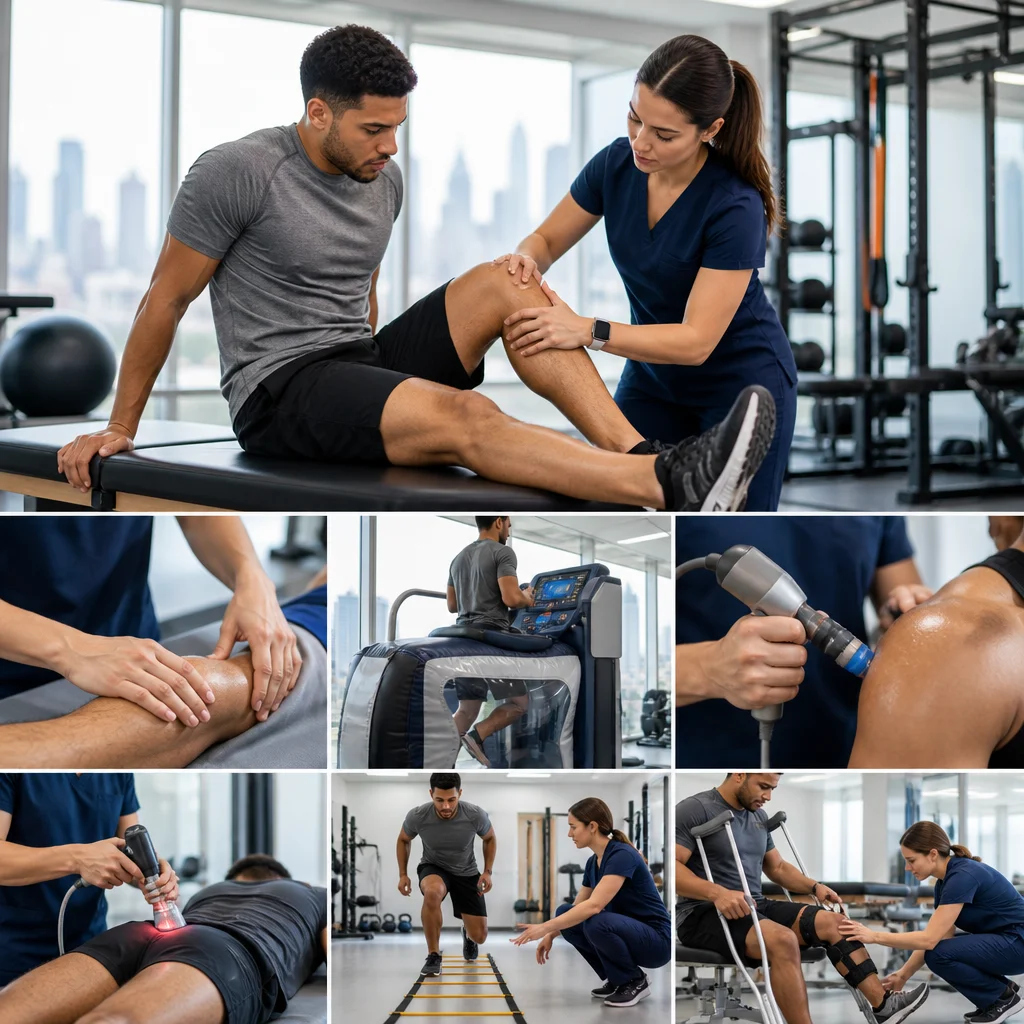
Manual therapy isn't generic massage. We apply specific joint mobilization techniques, soft tissue work, and myofascial release to address restrictions that standard exercises sometimes miss. Scar tissue adhesions often limit the final 10-20 degrees of motion, and manual therapy directly addresses these restrictions.
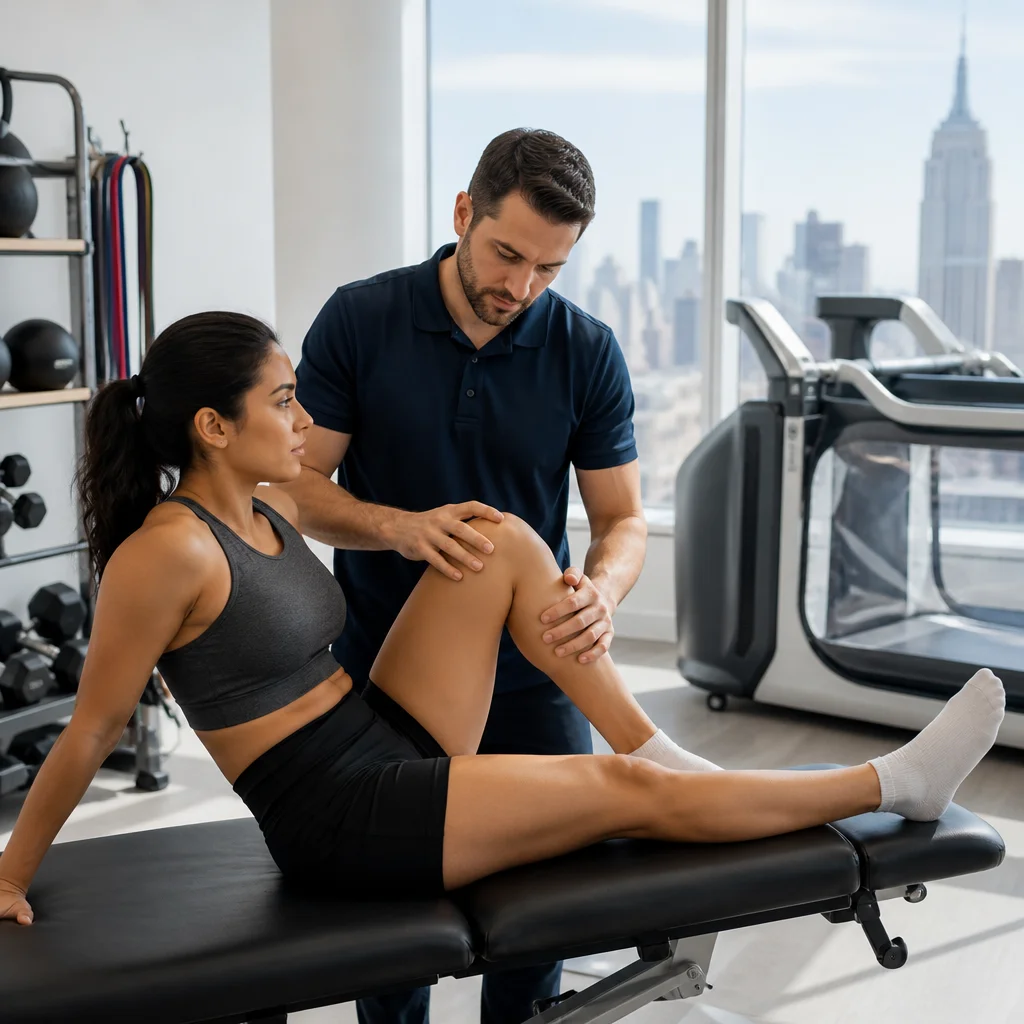
Our therapists assess your patellar mobility (how freely your kneecap glides), tibiofemoral joint mechanics (how your shin bone moves relative to your thigh bone), and fascial restrictions in your calf, hamstring, and quadriceps. Restrictions in any of these structures create compensatory movement patterns that slow your return to sport.
One common example: athletes with limited knee extension often develop increased motion at the hip, ankle, or lower back to compensate. We identify and correct these patterns during this phase so that when you return to cutting and pivoting movements, your mechanics are sound and efficient.
This phase also includes targeted soft tissue work around the repair site to manage scar tissue remodeling in a way that preserves tissue quality.
Actionable takeaway: Ask your physical therapist to teach you which specific manual techniques they're using and why. Request that they show you how to self-mobilize with foam rollers and massage tools so you can maintain gains between sessions.
5. Anti-Gravity Treadmill Training for Pain-Free Strengthening
Weeks 8-14 is when many athletes begin to feel psychologically ready for real training, but traditional treadmill running still creates joint loading that your repair might not tolerate. This is where anti-gravity treadmill therapy becomes invaluable.
An anti-gravity treadmill reduces your body weight through pressurized air while you run, allowing you to build cardiovascular fitness and lower-body muscular endurance without full joint impact. We typically begin at 50-70% of your body weight and progressively increase the load as strength improves.
This tool solves a unique problem: you're strong enough to run, but your repair tissue isn't quite ready for full impact. Traditional physical therapy options leave a gap here. The anti-gravity treadmill bridges that gap, letting you maintain aerobic capacity and running-specific motor patterns while your meniscus continues to mature.
Typically, athletes spend 4-6 weeks building from 20-minute sessions at reduced body weight to 30-40 minutes at 80-90% body weight. By week 12-14, you transition back to outdoor or conventional treadmill running with confidence and conditioning intact.
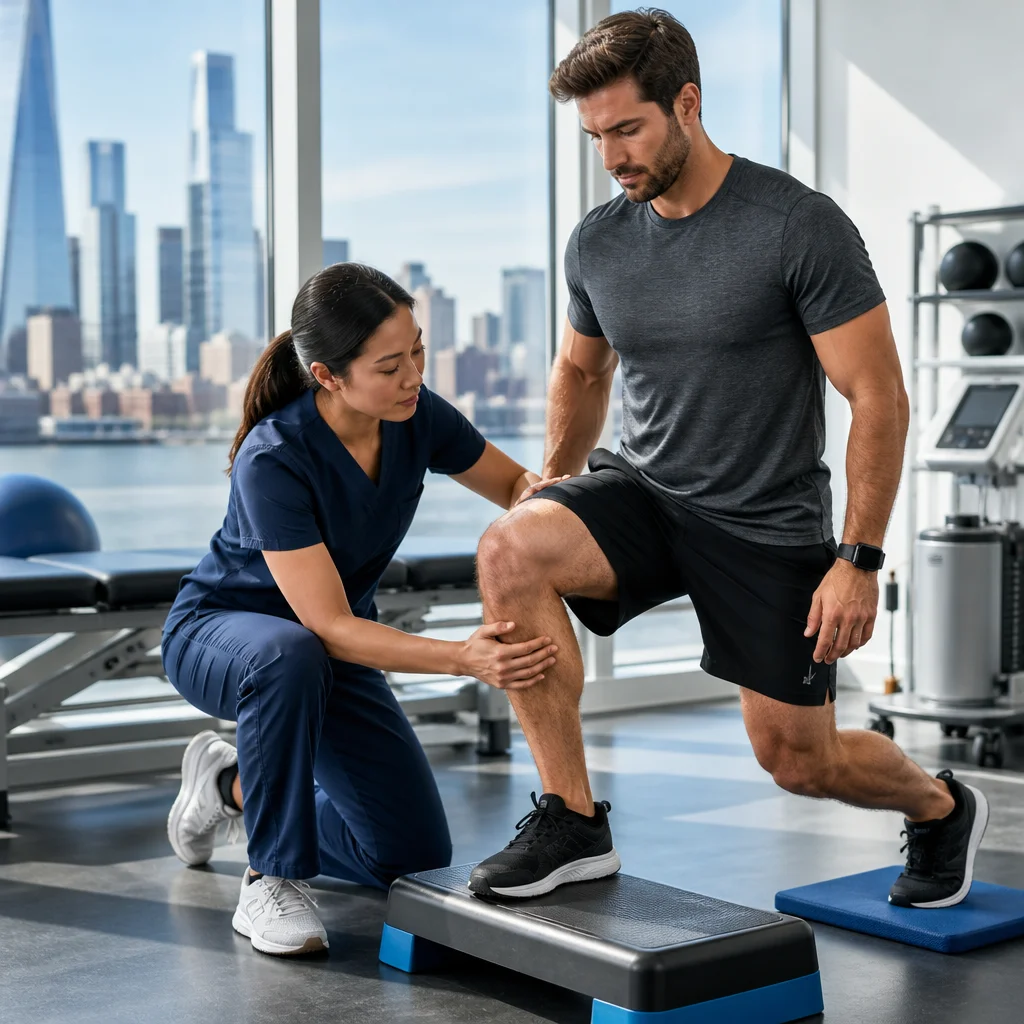
We pair anti-gravity training with on-ground strength work: single-leg squats, lateral lunges, step-ups, and rotational core exercises. This combination prepares your knee for the demands of sport-specific movement.
Actionable takeaway: Schedule 2-3 anti-gravity treadmill sessions per week during weeks 8-14, beginning at your surgeon's recommended body weight percentage. Increase body weight load by 10% every 2 weeks as tolerated.
6. Sport-Specific Return to Play Conditioning
Weeks 12-16 shifts focus to the movements that actually matter for your sport. This phase requires sport-specific analysis: what demands does your sport place on the knee, and how do we systematically prepare your body to handle those demands?
A basketball player needs lateral agility and vertical power. A distance runner needs endurance and impact tolerance. A tennis player needs explosive lateral changes and rotational control. These are fundamentally different training focuses.
We assess your movement quality during sport-specific tasks: your cutting mechanics during lateral drills, your landing patterns during jumping activities, your rotational control during pivot movements. Video analysis helps identify compensatory patterns that higher injury risk.
Sport-specific training progresses in intensity and complexity:
Weeks 12-13: Controlled drills at 75% effort (lateral shuffles, forward-backward runs, figure-8 patterns)
Weeks 13-14: Increased speed and agility (ladder drills, cone drills, sport-specific footwork)
Weeks 14-15: Sport-specific skill integration at game intensity with fatigue (scrimmage-like drills, position-specific movements, high-volume repetition)
Week 16+: Full return to practice and competition clearance pending surgical and clinical evaluation
Throughout this phase, we monitor your response. Increased swelling, pain, or movement compensation signals the need to scale back and rebuild more gradually.
Actionable takeaway: Video-record yourself performing sport-specific drills and compare your injured leg's movement to your uninjured leg. Look for asymmetries in cutting mechanics, landing patterns, or rotational control. Share these videos with your physical therapist for targeted feedback.
7. Laser and Shockwave Therapy to Accelerate Recovery
Advanced modalities can meaningfully accelerate tissue healing when integrated into a comprehensive program. Class IV laser therapy uses photonic energy to stimulate cellular regeneration and reduce inflammation at the tissue level. Shockwave therapy applies acoustic pulses that trigger the body's healing cascade and improve blood flow to compromised areas.
We typically introduce these modalities around weeks 6-8 as tissue maturation permits, and continue through the return-to-play phase. These aren't replacements for exercise and manual therapy; they're adjuncts that amplify what your body is already working to accomplish.
The evidence supporting laser therapy for tissue healing is particularly robust for tendons and ligaments, and the principles apply to meniscal tissue as well. Shockwave therapy has demonstrated effectiveness in accelerating bone and soft tissue repair, especially when combined with progressive loading.
Many athletes report subjective improvements in swelling reduction, pain levels, and overall healing sensation when these modalities are included, which translates to improved compliance with rehabilitation exercises and earlier confidence in their knee.
Actionable takeaway: Discuss with your surgeon and physical therapist whether laser or shockwave therapy is appropriate for your specific repair type. If approved, plan for 6-10 sessions beginning around week 6 post-op, combined with progressive strengthening work.
---
Returning to play after meniscus repair is entirely achievable when you follow a structured, evidence-based protocol designed around your specific injury and sport. Each phase builds on the previous one, and shortcuts at any stage compromise your long-term outcome.
At NYPT Health and Rehab, we specialize in exactly this journey. Our one-on-one physical therapy sessions are tailored specifically to your repair type, your sport, and your goals. We combine manual therapy, advanced modalities, anti-gravity treadmill training, and sport-specific conditioning under one roof, which means your treatment stays coordinated and progressive from your first post-op session through your return to competition.
If you're navigating meniscus repair recovery in New York City, we'd welcome the opportunity to partner with you. Your path back to peak performance starts with the right team supporting every step of the way.
Frequently Asked Questions (FAQ)
How long does meniscus repair recovery typically take before I can return to my sport?
We generally guide our patients through a 4-6 month recovery timeline for most meniscus repairs, though this varies based on the tear severity, repair type, and your specific sport. We work closely with you from day one to gradually progress your rehabilitation, monitoring your healing milestones before advancing to sport-specific training. Our team uses clinical assessments and imaging feedback to determine when you're ready for each phase of return to play.
What makes your meniscus rehabilitation approach different from standard physical therapy?
We combine advanced manual therapy techniques with cutting-edge technology like our anti-gravity treadmill and Class IV laser therapy to accelerate healing while protecting your repair during early recovery phases. Our one-on-one sessions are personalized to your sport and goals, and we integrate sports-specific conditioning as you progress rather than using generic protocols. We also incorporate yoga and massage therapy to address compensatory patterns and maintain mobility throughout your recovery journey.
When can I start running or playing sports again after meniscus repair?
We typically introduce pain-free walking on our anti-gravity treadmill around week 6-8, with gradual progression to running based on your individual healing response. Sport-specific return to play training begins around month 3-4 once you've rebuilt adequate strength and proprioception through our comprehensive conditioning program. We never rush this process—we make clearance decisions based on your functional performance in our clinic, not arbitrary timelines.
Comments