

Integrated Physical Therapy and Massage Services for NYC Athletes
Table of Contents
Our Integrated Therapy Model: Why Combining Services Accelerates Results
Advanced Manual Therapy Techniques Within Our Integrated Approach
Massage Therapy Integration for Muscle Recovery and Mobility
How Our Anti-Gravity Treadmill Complements Integrated Treatment
Real Recovery Timelines: What Our Integrated Approach Achieves
Why Athletes Need Combined Physical Therapy and Massage
As an active New Yorker, you know that injuries don't just sideline your body, they disrupt your entire life. The commute becomes painful. Your favorite workout disappears. Your competitive edge dulls. What you need isn't just someone to treat your symptoms in isolation, but a coordinated recovery strategy that addresses every layer of your injury.
At NYPT Health & Rehab, we've built our practice around a simple truth: the best results come when physical therapy and massage work together from day one. Rather than bouncing between separate clinics and hoping two different providers understand your overall plan, you get one cohesive team focused on your complete recovery. This integrated approach is why our athletes return to their peak performance faster and with greater confidence.
Your injury isn't one-dimensional. A rotator cuff strain involves inflammation, muscle tightness, movement dysfunction, and sometimes poor mechanics that created the problem in the first place. Addressing only the inflammation while ignoring the tension won't get you back to your sport. Treating the tightness without fixing the underlying movement pattern guarantees another injury down the road.
Physical therapy excels at restoring movement patterns, building strength, and retraining your nervous system. Massage therapy specializes in releasing soft tissue restrictions, improving blood flow, and reducing muscle guarding that limits your progress. When these two services happen in the same clinic with the same treatment philosophy, something powerful occurs: each session builds on the last, and your recovery accelerates.
Consider a runner with a hamstring injury. PT identifies the glute weakness that's overloading your hamstring. Massage releases the muscle tension that's preventing you from achieving the full range of motion needed for your strengthening exercises. Together, they solve the actual problem rather than treating symptoms forever.
What to do next: Schedule a consultation that addresses your whole injury story, not just the painful spot.
How Separated Treatment Approaches Limit Your Recovery
Many athletes see a physical therapist on Tuesday and a massage therapist on Thursday, with no communication between them. This creates three immediate problems.
First, duplication and confusion. Your PT prescribes specific stretches; your massage therapist may spend 30 minutes undoing the direction of your treatment without realizing it. Different approaches to your recovery create competing stimulus rather than compounding results.
Second, you lose critical context. A massage therapist treating your shoulder doesn't know about the postural dysfunction your PT identified. Your PT doesn't know that your massage therapist found a trigger point pattern that explains why certain movements aggravate you. This gap in communication means both providers are working with incomplete information.
Third, progress stalls because one limiting factor remains unaddressed. Your PT gets you 60 percent stronger, but muscle tightness prevents you from using that strength functionally. Massage temporarily relieves the tightness, but without PT's movement retraining, the tension returns within days. You pay for two services yet see delayed results from both.
Separated approaches also place the burden entirely on you to synthesize information and coordinate care. You're remembering instructions from one provider, explaining them to another, and hoping you're actually following a coherent plan.
What to do next: Ask potential providers whether they collaborate with other services on your treatment plan, or whether you're essentially managing your own care between locations.
Our Integrated Therapy Model: Why Combining Services Accelerates Results
Our integrated model means your PT and massage therapist review your case together, understand your goals, and build a single coordinated plan. Your PT might identify that you need aggressive soft tissue work before strengthening exercises will take hold, so massage happens first in your recovery sequence. Or your PT prescribes specific movement patterns that your massage therapist reinforces by releasing the tissues preventing those patterns.
Every session connects to your larger recovery arc. When you arrive for your appointment, your provider knows exactly what was accomplished last time, what barriers remain, and what the next step is. There's no handoff, no confusion, no starting from scratch.
This coordination accelerates results because each service amplifies the other. Massage preps your muscles for the demanding therapeutic exercises your PT prescribes. PT retrains your movement patterns so you don't re-tension the muscles that massage just released. The synergy compounds over weeks, not months.
Our athletes notice this difference immediately. Sessions feel purposeful. Progress compounds week to week. Recovery timelines shrink. Most importantly, you feel confident that someone is managing your total recovery, not just treating an isolated symptom.
What to do next: Look for clinics where your therapist and massage provider communicate before and after your sessions, not weeks later.
One-on-One Physical Therapy as Your Foundation
Every recovery plan at our clinic starts with personalized one-on-one physical therapy. This means a licensed PT evaluates your entire movement system, not just your injured area. We assess your strength, flexibility, stability, and movement patterns to understand why the injury happened and what needs to change to prevent recurrence.
One-on-one sessions let us progress your treatment week by week based on your actual improvement, not a pre-set protocol. If your knee stabilizer muscles respond faster than expected, we advance faster. If inflammation lingers, we adjust. You get a customized roadmap, not a generic path that works for most people.
Your PT also teaches you how to move safely throughout daily life. That means showing you how to climb subway stairs without irritating your shoulder, how to sit at your desk without aggravating your back, and how to train around your injury. These functional insights matter more than any single exercise.
Advanced Manual Therapy Techniques Within Our Integrated Approach
Manual therapy encompasses hands-on techniques like joint mobilizations, soft tissue work, and neuromuscular re-education that our PTs apply to restore normal movement and reduce pain. These techniques work beautifully with our massage integration because they address similar tissues through different mechanisms.
While massage releases tension and improves circulation, manual therapy addresses restrictions in how your joints move and how your nervous system controls movement. An athlete with a stiff shoulder might receive joint mobilization from your PT to restore normal scapular mechanics, then massage to release the muscles guarding that restriction. The combination is far more effective than either alone.
These techniques require expertise and a hands-on evaluation. That's why we spend time understanding your specific restrictions rather than applying the same techniques to every athlete with a similar diagnosis.
Massage Therapy Integration for Muscle Recovery and Mobility
Our integrated deep tissue massage NYC services go far beyond relaxation. Sports massage addresses the muscle tightness and trigger points that limit your progress in physical therapy and reduce your athletic performance.
Tight muscles restrict your range of motion, create compensation patterns, and feel worse after intense training. Massage releases these restrictions, improves blood flow to speed recovery, and allows your muscles to function properly. When coordinated with PT, this creates the ideal environment for strengthening exercises to work.
We also use massage strategically. Early in recovery from a swollen injury, gentle techniques promote circulation and reduce protective muscle guarding. As you progress, deeper work addresses the scar tissue and adhesions that can limit you months into recovery. The type and intensity of massage evolves as your injury does.
How Our Anti-Gravity Treadmill Complements Integrated Treatment
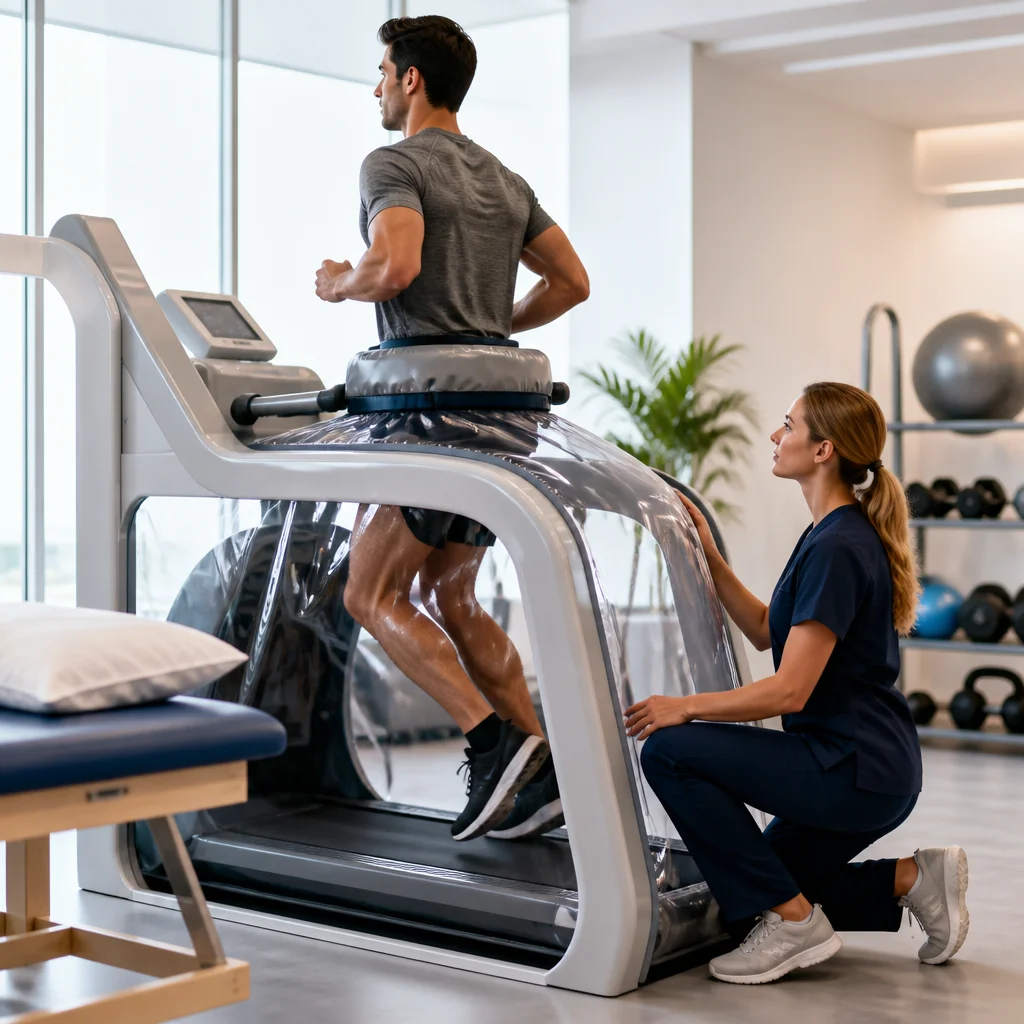
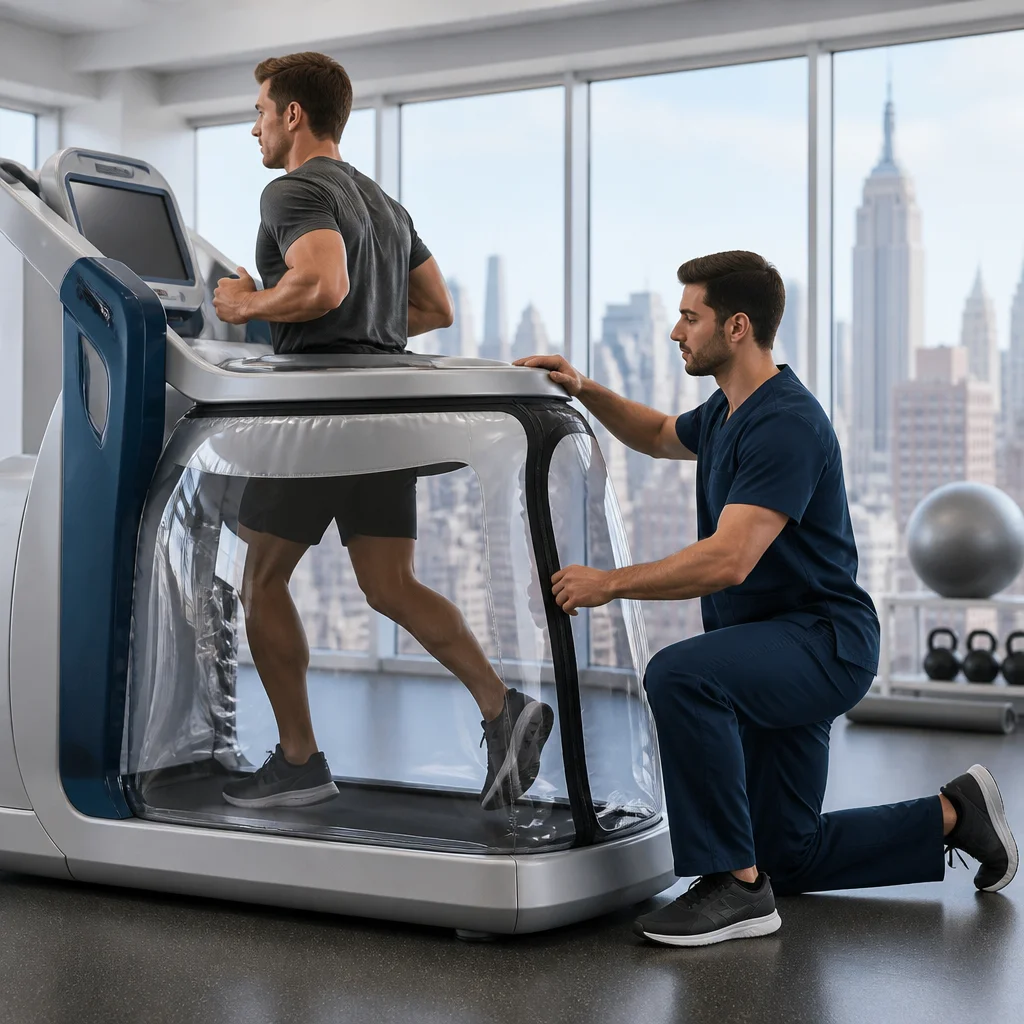
Our anti-gravity treadmill is a game-changer for runners and athletes recovering from lower limb injuries. This technology uses air pressure to reduce your body weight, letting you train running or walking patterns with 20 to 50 percent less impact. This means you can restore cardiovascular fitness and movement patterns while your tissues are still healing.
In your integrated plan, the anti-gravity treadmill becomes a bridge between early rehab and return to sport. Your PT uses it to retrain your running mechanics without the impact that would set back your recovery. Massage happens before or after to manage any muscle soreness from this new stimulus. You progress faster because you're maintaining fitness while healing.
Athletes particularly appreciate this tool because it keeps them moving toward their goals rather than sitting idle during recovery. That psychological boost, combined with the actual tissue protection, transforms the rehabilitation experience.
Laser and Shockwave Therapy Within Your Comprehensive Plan
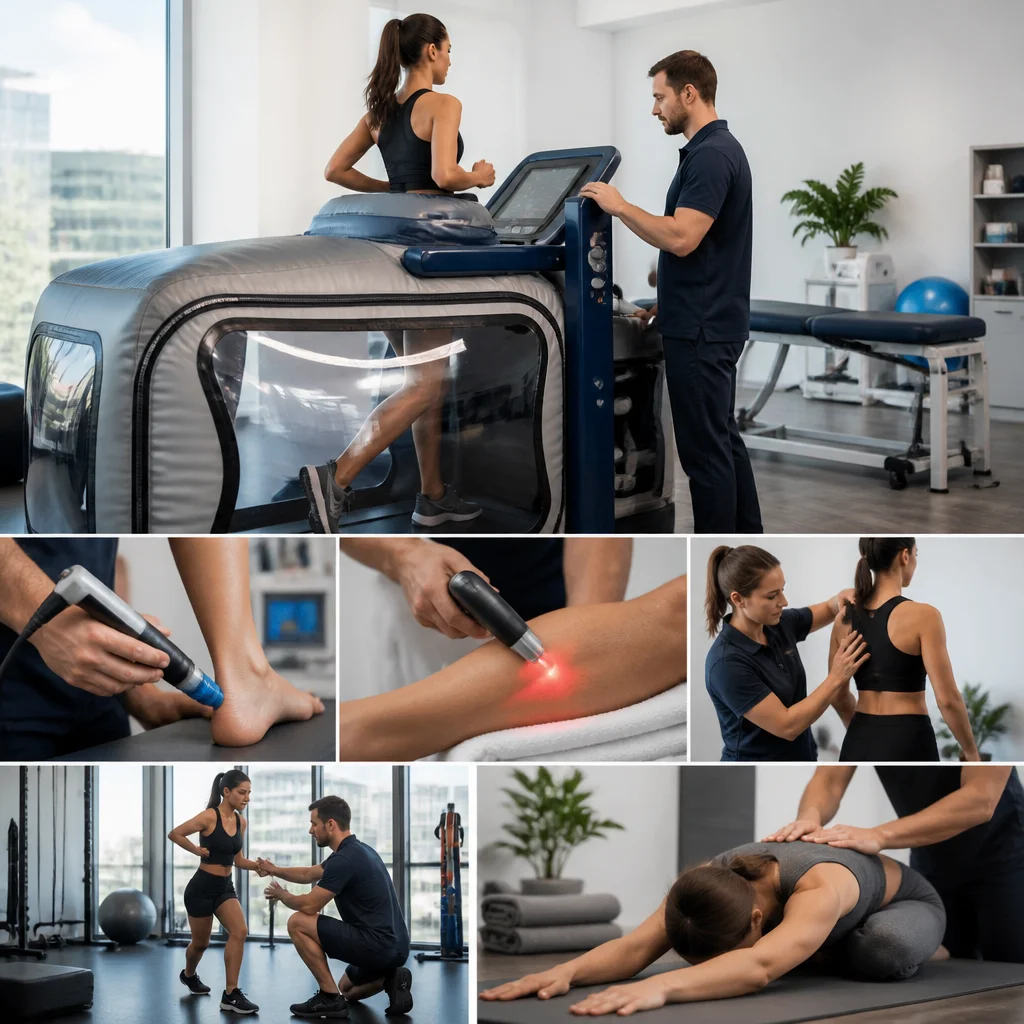
Class IV laser therapy and shockwave therapy address inflammation and stimulate tissue healing at the cellular level. Both technologies accelerate your body's natural healing processes, which means you respond faster to your strengthening program and functional training.
These modalities aren't magic cures, but they are powerful tools within an integrated plan. Laser therapy might reduce your shoulder inflammation enough that your PT can progress your exercises two weeks faster. Shockwave therapy on an Achilles tendon issue allows you to tolerate the loading demands of return-to-sport training sooner. Each tool serves a specific purpose in your overall recovery timeline.
We integrate them strategically. Laser or shockwave might happen early to address acute inflammation. As you progress into strengthening and sport-specific training, the focus shifts to exercise and conditioning. The technologies support your primary recovery work, not replace it.
Return to Action: Strength and Conditioning With Our Team
Getting pain-free isn't the same as getting back to your sport. You need specific strength, power, and movement patterns that match your athletic demands. Our return to action strength and conditioning program bridges the gap between "recovered" and "ready."
Your PT designs sport-specific exercises that prepare you for the demands you'll face. If you're a soccer player, that means rotational power and rapid direction changes. A weightlifter needs stability under heavy loads. A tennis player requires explosive lateral movement. Generic strengthening won't cut it.
We also provide the confidence testing that lets you know you're truly ready. Before you return to full sport, you prove you can meet the physical demands. That removes doubt and reduces injury recurrence risk.
Real Recovery Timelines: What Our Integrated Approach Achieves
Recovery timelines vary based on your injury type, severity, and how quickly your tissues respond. But integrated care consistently delivers faster results than siloed treatment.
A moderate rotator cuff strain might take 8 to 12 weeks with fragmented care. With integrated rehab, athletes typically return to their sport in 6 to 8 weeks because every session compounds. A post-surgical ACL rehabilitation might take 6 months with coordinated care versus 8-9 months with separated PT and massage. That's real time back to your life.
These timelines assume consistent effort on your part. Athletes who commit to their program and communicate openly with their team progress faster than those who miss sessions or don't engage with home exercises.
Getting Started With Your Personalized Recovery Program
The first step is a comprehensive evaluation where we understand your injury, your goals, and your timeline. This isn't a quick screening, it's a thorough assessment that guides your entire plan.
Bring any relevant imaging or medical reports. Tell us about your sport, your training schedule, and what returning to full performance means to you. The more we understand about your life, the better we can design recovery that fits your reality.
From there, we'll outline your integrated plan: how often you'll attend PT, when massage will be most beneficial, whether technologies like laser or anti-gravity training apply to your situation, and what you'll do at home between sessions. You'll have clarity on timeline, cost, and what success looks like.
Recovery doesn't have to be a lonely, fragmented process. At NYPT Health & Rehab, it's a coordinated journey back to the activities you love. Schedule your evaluation today and experience the difference integrated care makes.
Frequently Asked Questions (FAQ)
How do we structure our integrated physical therapy and massage sessions?
We combine one-on-one physical therapy with massage therapy within a personalized treatment plan designed specifically for your injury and goals. During your sessions, we use advanced manual therapy techniques alongside massage to address muscle tension, improve mobility, and support your body's healing process. Our therapists coordinate these approaches so that each treatment builds on the previous one, maximizing your recovery efficiency rather than treating these services separately.
What makes our integrated approach faster than traditional physical therapy alone?
We've found that combining physical therapy with massage therapy accelerates recovery because massage prepares your muscles for therapeutic work while physical therapy builds strength and movement patterns. This coordination reduces recovery time by addressing both soft tissue restrictions and functional deficits simultaneously, rather than having you seek these services in isolation. We also integrate complementary tools like our anti-gravity treadmill, laser therapy, and shockwave therapy into your plan based on your specific needs.
How quickly can we get active athletes back to their sport?
Our recovery timelines vary depending on your injury severity and type, but we've designed our integrated model to optimize your return to action. We work with you through progressive strength and conditioning phases, using real-time assessment to determine when you're ready for sport-specific training. We combine all our advanced techniques and personalized attention to help you regain peak performance safely and sustainably.
Comments